
 Anabelle McLean
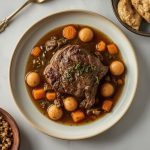
 Joy of Cooking Beef Stew is a stovetop classic that turns humble chuck roast into something deeply savory and fork-tender. Cubes of beef get seared until mahogany-brown, then simmer low and slow with carrots, Yukon Gold potatoes, and pearl onions in a pork-free, alcohol-free broth. The result is a glossy, rich gravy that clings to every spoonful.
Total time runs about 3 hours, with 30 minutes of that being prep. It sits at an intermediate level — mostly because the searing step demands patience and a hot pan. Make it on a cold Sunday when you want the house to smell like dinner for hours.
What is Joy of Cooking Beef Stew?
This is a braised beef stew built on layers of browning. Chuck roast is cut into chunks, dusted with flour, and seared hard before it ever meets liquid. What you get in the bowl is meat that shreds under a fork, vegetables with a little bite left, and a gravy thick enough to coat the back of a spoon. It is American comfort food at its most straightforward.

Why You Should Try This Recipe
Here is what makes this one worth the time in the kitchen.
- Deep flavor from real browning — Searing in three separate batches builds a fond on the pot bottom that becomes the backbone of the gravy.
- No wine, no pork needed — Tomato paste, Worcestershire sauce, and beef broth carry all the savory depth on their own.
- Hands-off simmering — Once the pot is covered, it mostly cooks itself for 90 minutes while you get on with your day.
- Better the next day — The flavor deepens overnight, which makes it a smart make-ahead meal for company.
- Works stovetop or oven — An oven alternative lets you skip the stirring if you prefer a fully hands-off approach.
Ingredients Needed to Make Joy of Cooking Beef Stew
You probably have a few of these already. The rest are easy to find at any grocery store.
For the Beef
- 2 1/2 lb boneless beef chuck roast — Trimmed of excess fat and cut into 1 1/2-inch cubes. Chuck is the right cut here because its connective tissue breaks down into gelatin during the long simmer.
- 2 tsp kosher salt — Plus more to taste at the end. Kosher salt dissolves more evenly than table salt on raw meat.
- 1 tsp freshly ground black pepper — Freshly ground makes a real difference in a dish this simple.
- 3 tbsp all-purpose flour — Coats the beef to help it brown and lightly thickens the broth as it cooks.
- 3 tbsp vegetable oil — A neutral, high-smoke-point oil that can handle the heat of searing.
For the Base and Broth
- 1 large yellow onion — Roughly chopped, about 1 1/2 cups. It softens into the gravy and adds sweetness.
- 3 medium garlic cloves — Minced, about 1 tbsp. Add it last so it does not burn.
- 2 tbsp tomato paste — Cooked into the onions until it darkens slightly for a deeper, less sharp tomato flavor.
- 4 cups low-sodium beef broth — Plus more if needed. Low-sodium lets you control the final seasoning.
- 1 tbsp Worcestershire sauce — Choose a pork-free and alcohol-free brand and check the label.
- 2 tsp dried thyme — Earthy and woodsy, it pairs naturally with beef.
- 2 dried bay leaves — Removed before serving.
For the Vegetables
- 1 lb Yukon Gold potatoes — Peeled and cut into 1-inch chunks. They hold their shape better than russets.
- 4 medium carrots — Peeled and cut into 1-inch pieces.
- 8 oz pearl onions — Fresh or frozen. If frozen, thaw and pat them dry so they do not water down the gravy.
For the Finish
- 2 tbsp unsalted butter, softened — At room temperature so it mashes smoothly into the flour.
- 2 tbsp all-purpose flour — Combined with the butter to make a beurre manié.
- 2 tbsp chopped fresh flat-leaf parsley — For garnish. Flat-leaf has more flavor than curly.
Step by Step Instructions to Prepare Joy of Cooking Beef Stew
The method is mostly about patience — searing well and simmering gently. Follow the steps in order and the pot does the rest.
- Dry and Season the Beef — Pat the cubes completely dry with paper towels, then toss with 2 tsp kosher salt and 1 tsp black pepper. Sprinkle with 3 tbsp flour and toss again until evenly coated. Let it sit at room temperature for 20 minutes while you prep the vegetables.
- Sear in Three Batches — Heat 3 tbsp vegetable oil in a large Dutch oven over medium-high until it shimmers and a cube sizzles immediately. Sear the beef on all sides until deeply browned, about 5–7 minutes per batch. Move each batch to a plate and do not scrape the pot between batches.
- Build the Base — Lower the heat to medium and add the chopped onion to the same pot. Cook, stirring occasionally and scraping up the browned bits, until softened and lightly golden, about 5 minutes. Add the garlic and cook 30 seconds, then stir in the tomato paste and cook 1 minute more, mashing it into the onions until it darkens slightly.
- Deglaze and Add Liquid — Pour in 1 cup of the beef broth and bring to a simmer, scraping the bottom vigorously with a wooden spoon to dissolve all the fond. Simmer 2 minutes. Return the seared beef and its juices, then add the remaining 3 cups broth, 1 tbsp Worcestershire sauce, 2 tsp dried thyme, and 2 bay leaves. The liquid should just cover the meat — add a splash more broth if needed.
- Simmer the Beef — Bring to a boil over medium-high, then reduce the heat to low, cover, and maintain a gentle simmer. Cook 1 hour and 30 minutes, stirring every 20 minutes, until the beef is nearly tender when pierced with a paring knife. Keep the liquid bubbling slowly, never vigorously, so the meat does not toughen.
- Add the Vegetables — Stir in the potatoes, carrots, and pearl onions, pressing them down into the liquid. Cover and simmer another 30–40 minutes, until the vegetables are fork-tender and the beef shreds easily. If either is still firm, simmer 10 minutes longer.
- Make the Beurre Manié — While the vegetables cook, mash together 2 tbsp softened butter and 2 tbsp flour with a fork until a smooth paste forms. Set it aside at room temperature. This is what gives the gravy its glossy body without a raw flour taste.
- Thicken the Gravy — Remove and discard the bay leaves. Raise the heat to medium and bring to a low boil. Whisk in the beurre manié a little at a time, stirring constantly, and simmer 3–5 minutes until the broth coats the back of a spoon. Thin with a splash of broth if too thick, or simmer uncovered if too thin.
- Season and Rest — Season with additional kosher salt and black pepper, starting with 1/2 tsp salt and 1/4 tsp pepper. Stir in half the parsley, then remove from heat and rest 5 minutes so the flavors meld and the sauce settles.
- Serve — Ladle into warmed bowls, making sure each portion gets a generous share of beef and vegetables. Garnish with the remaining parsley and serve hot.
- Oven Alternative — After adding the liquid, transfer the covered pot to a preheated 325°F / 165°C oven and cook 1 hour 30 minutes. Add the vegetables, return to the oven, and cook 30–40 minutes more. Finish with the beurre manié on the stovetop as directed.

What Goes Well With Joy of Cooking Beef Stew
The gravy is the star here, so anything that soaks it up earns a spot on the table.
- Crusty sourdough bread — Tear off a hunk and swipe it through the gravy. No butter required.
- Buttered egg noodles — A classic pairing that turns the stew into something closer to a full plate of comfort food.
- Creamy mashed potatoes — Spoon the stew right over the top and let everything run together.
- Simple green salad — A sharp vinaigrette cuts through the richness of the beef and gravy.
- Dry red wine or dark beer — Neither goes into the pot, but either works alongside it if you drink. Sparkling water with lemon is just as good.
- Cornbread or buttermilk biscuits — Southern-leaning, but they soak up that glossy sauce beautifully.
Essential Tips for Perfecting Joy of Cooking Beef Stew
These are the details that separate a good pot from a great one.
- Dry the beef thoroughly — Surface moisture steams instead of sears. Wet cubes will never get that mahogany crust you want.
- Do not crowd the pot — Three batches is not optional. Overcrowding drops the pan temperature and the beef ends up gray and steamed.
- Scrape the fond properly — Those browned bits stuck to the bottom are concentrated flavor. The broth you pour in is your chance to lift them all up.
- Keep the simmer gentle — A hard boil tightens the meat fibers and makes chuck chewy. Low and slow is what gives you fork-tender results.
- Add vegetables late — They go in after 90 minutes of cooking, not at the start. Any earlier and they turn to mush.
- Thicken at the end, not the start — The beurre manié goes in once the vegetables are tender so you can judge the final consistency accurately.
- Rest before serving — Five minutes off the heat lets the sauce settle and the flavors come together. Skipping this makes the stew taste flatter.
Variations of Joy of Cooking Beef Stew
Once you know the base method, it is easy to shift it in other directions.
- Herb-forward version — Swap the dried thyme for 1 tbsp fresh thyme and add a sprig of rosemary during the simmer. Remove the woody stems before serving.
- Mushroom addition — Sauté 8 oz of quartered cremini mushrooms with the onions for extra umami and a meatier texture.
- Root vegetable swap — Replace the potatoes with parsnips and rutabaga for a slightly sweeter, more earthy bowl.
- Thicker, gravy-heavy stew — Increase the beurre manié to 3 tbsp butter and 3 tbsp flour if you like a sauce that really clings to the spoon.
- Slow cooker adaptation — Sear the beef and build the base on the stovetop first, then transfer everything to a slow cooker and cook on low for 6–7 hours. Add the vegetables in the last 90 minutes.
- Smoky twist — Add 1 tsp smoked paprika with the tomato paste for a subtle campfire note that pairs well with cornbread.
Storing Joy of Cooking Beef Stew: Best Practices
Make a big batch — leftovers are arguably better than the first bowl.
- Refrigerator storage — Cool the stew completely, then refrigerate in an airtight container for up to 4 days. The flavor improves after a day.
- Freezer storage — Freeze in portioned containers for up to 3 months. Thaw overnight in the refrigerator before reheating.
- Portioning tip — Divide into single-serve containers before freezing so you only thaw what you need.
- Cooling quickly — Spread the stew in a shallow dish to cool faster before chilling. Large pots of hot stew take hours to cool safely otherwise.
- Labeling — Write the date on the container. Stew looks the same at week one and week four in the freezer.
Reheating Joy of Cooking Beef Stew: Best Practices
Gently does it — a rolling boil is the enemy of tender vegetables.
- Stovetop reheating — Warm gently over medium-low heat, stirring occasionally, until steaming hot, about 10–15 minutes. Do not boil vigorously or the vegetables may break apart.
- Microwave method — Heat individual portions on high in 1-minute intervals, stirring between each, until hot. This is the fastest option for a single bowl.
- From frozen — Thaw first for best texture. Reheating straight from frozen works in a pinch but the potatoes tend to go grainy.
- Thinning if needed — If the stew thickens too much upon reheating, add a splash of beef broth or water and stir it through.
FAQs
Can I freeze Joy of Cooking Beef Stew?
Yes, and it freezes well. Portion it into airtight containers and freeze for up to 3 months. Thaw overnight in the refrigerator before reheating gently on the stovetop.
How long does Joy of Cooking Beef Stew last in the fridge?
Up to 4 days in an airtight container. Cool it completely before refrigerating, and reheat only the portion you plan to eat.
Can I make this in a slow cooker instead?
You can, but sear the beef and build the base on the stovetop first. The browning step is what gives the stew its depth, and a slow cooker cannot replicate it.
Why is my beef stew tough?
Usually it is undercooked or boiled too hard. Chuck needs a long, gentle simmer to break down its connective tissue. Keep the liquid at a slow bubble and give it the full time.
What is the best cut of beef for stew?
Boneless chuck roast is the ideal choice. It has enough fat and connective tissue to turn tender and flavorful after a long braise, unlike leaner cuts that dry out.
Can I skip the beurre manié?
You can, but the gravy will be thinner. The butter-flour paste is what gives the stew its glossy, velvety body. If you skip it, simmer uncovered for a few extra minutes to reduce the liquid.
Final Words
A good pot of Joy of Cooking Beef Stew rewards patience more than skill. Sear the meat properly, keep the simmer gentle, and let the vegetables go in at the right moment. Do that and you get a bowl that tastes like it took all day — because it did, in the best way. Give it a try this weekend and see what your kitchen smells like three hours later.
Print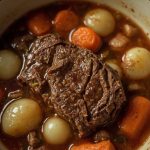
Joy of Cooking Beef Stew
- Prep Time: 30
- Cook Time: 150
- Total Time: 180
- Yield: 4 1x
- Category: Main Course
- Method: Stovetop (with oven alternative)
- Cuisine: American
Description
A deeply savory, fork-tender beef stew inspired by the classic Joy of Cooking method. Chuck roast is seared until mahogany-brown, then slowly simmered with carrots, potatoes, and pearl onions in a red wine–free, pork-free broth until the gravy is glossy and rich. Each bowl is hearty, comforting, and built on layers of browning and deglazing for maximum flavor.
Ingredients
- 2 1/2 lb boneless beef chuck roast, trimmed of excess fat and cut into 1 1/2-inch cubes
- 2 tsp kosher salt, plus more to taste
- 1 tsp freshly ground black pepper
- 3 tbsp all-purpose flour
- 3 tbsp vegetable oil
- 1 large yellow onion, roughly chopped (about 1 1/2 cups)
- 3 medium garlic cloves, minced (about 1 tbsp)
- 2 tbsp tomato paste
- 4 cups low-sodium beef broth, plus more if needed
- 1 tbsp Worcestershire sauce (pork-free and alcohol-free; check label)
- 2 tsp dried thyme
- 2 dried bay leaves
- 1 lb Yukon Gold potatoes, peeled and cut into 1-inch chunks
- 4 medium carrots, peeled and cut into 1-inch pieces
- 8 oz pearl onions, fresh or frozen (if frozen, thaw and pat dry)
- 2 tbsp unsalted butter, softened at room temperature
- 2 tbsp all-purpose flour (for beurre manié)
- 2 tbsp chopped fresh flat-leaf parsley, for garnish
Instructions
- Pat the beef cubes completely dry with paper towels. In a large bowl, toss the beef with 2 tsp kosher salt and 1 tsp black pepper, then sprinkle with 3 tbsp flour and toss again until evenly coated. Let the beef sit at room temperature for 20 minutes while you prep the vegetables; this ensures even cooking and better browning.
- Heat 3 tbsp vegetable oil in a large Dutch oven or heavy-bottomed pot over medium-high heat until the oil shimmers and a cube of beef sizzles immediately when added. Working in three batches to avoid crowding, sear the beef on all sides until deeply browned, about 5–7 minutes per batch. Transfer each batch to a plate and set aside; do not scrape the pot between batches.
- Reduce the heat to medium and add the chopped yellow onion to the same pot. Cook, stirring occasionally and scraping up the browned bits, until the onion is softened and lightly golden, about 5 minutes. Add the minced garlic and cook for 30 seconds until fragrant, then stir in the tomato paste and cook for 1 minute more, mashing it into the onions until it darkens slightly.
- Pour in 1 cup of the beef broth and bring to a simmer, scraping the bottom of the pot vigorously with a wooden spoon to dissolve all the fond. Simmer for 2 minutes until the liquid reduces slightly. Return the seared beef and any accumulated juices to the pot, then add the remaining 3 cups broth, 1 tbsp Worcestershire sauce, 2 tsp dried thyme, and 2 bay leaves. The liquid should just cover the meat; add a splash more broth if needed.
- Bring the stew to a boil over medium-high heat, then reduce the heat to low, cover, and maintain a gentle simmer. Cook for 1 hour and 30 minutes, stirring every 20 minutes, until the beef is nearly tender when pierced with a paring knife. Adjust the heat as needed so the liquid bubbles slowly, never vigorously, to prevent the meat from toughening.
- After the beef has simmered for 1 hour and 30 minutes, add the potatoes, carrots, and pearl onions to the pot. Stir gently to submerge them in the liquid, then cover and continue simmering for 30–40 minutes, until the vegetables are fork-tender and the beef shreds easily with a fork. Taste a piece of beef and a potato to confirm doneness; if either is still firm, simmer 10 minutes longer.
- While the vegetables cook, make the beurre manié: in a small bowl, mash together 2 tbsp softened unsalted butter and 2 tbsp all-purpose flour with a fork until a smooth paste forms. Set aside at room temperature. This thickener will give the stew a glossy, velvety body without any raw flour taste.
- When the vegetables are tender, remove the bay leaves and discard. Increase the heat to medium and bring the stew to a low boil. Whisk in the beurre manié a little at a time, stirring constantly, and simmer for 3–5 minutes until the broth thickens enough to coat the back of a spoon. If the stew becomes too thick, thin with a splash of beef broth; if too thin, simmer uncovered for a few extra minutes.
- Season the stew with additional kosher salt and black pepper to taste, starting with 1/2 tsp salt and 1/4 tsp pepper. Stir in half of the chopped parsley. Remove from heat and let rest for 5 minutes so the flavors meld and the sauce settles.
- Ladle the stew into warmed bowls, making sure each portion gets a generous share of beef and vegetables. Garnish with the remaining parsley and serve hot. This stew is excellent with crusty bread, buttered egg noodles, or creamy mashed potatoes.
- Oven alternative: If you prefer hands-off cooking, after step 4 transfer the covered pot to a preheated 325°F / 165°C oven and cook for 1 hour 30 minutes. Then add the vegetables, return to the oven, and cook 30–40 minutes more, until tender. Finish with the beurre manié on the stovetop as directed.
Notes
Storage: Cool the stew completely, then refrigerate in an airtight container for up to 4 days. The flavor improves after a day. Freezing: Freeze in portioned containers for up to 3 months; thaw overnight in the refrigerator. Reheating: Warm gently on the stovetop over medium-low heat, stirring occasionally, until steaming hot, about 10–15 minutes. If reheating from frozen, thaw first for best texture; microwave individual portions on high in 1-minute intervals, stirring between, until hot. Do not boil vigorously or the vegetables may break apart. If the stew thickens too much upon reheating, add a splash of beef broth or water.
Nutrition
- Calories: 1023
- Sugar: 10g
- Sodium: 1423mg
- Unsaturated Fat: 20g
- Carbohydrates: 53g
- Fiber: 7g
- Protein: 61g
- Cholesterol: 198mg
Keywords: beef stew, Joy of Cooking beef stew, classic beef stew, stovetop beef stew, hearty beef stew, chuck roast stew, no wine beef stew, pork-free beef stew, winter comfort food, one-pot dinner, beef and vegetable stew, homemade beef stew